Last Updated
Affiliate links
Some links in this article are partner links (reklamelinks). If you click through and sign up or make a purchase, ExpatFinance.dk earns a commission at no extra cost to you. This helps cover the cost of running the site and keeping the content free. It doesn’t affect which products we cover or what we say about them.
Quick Summary
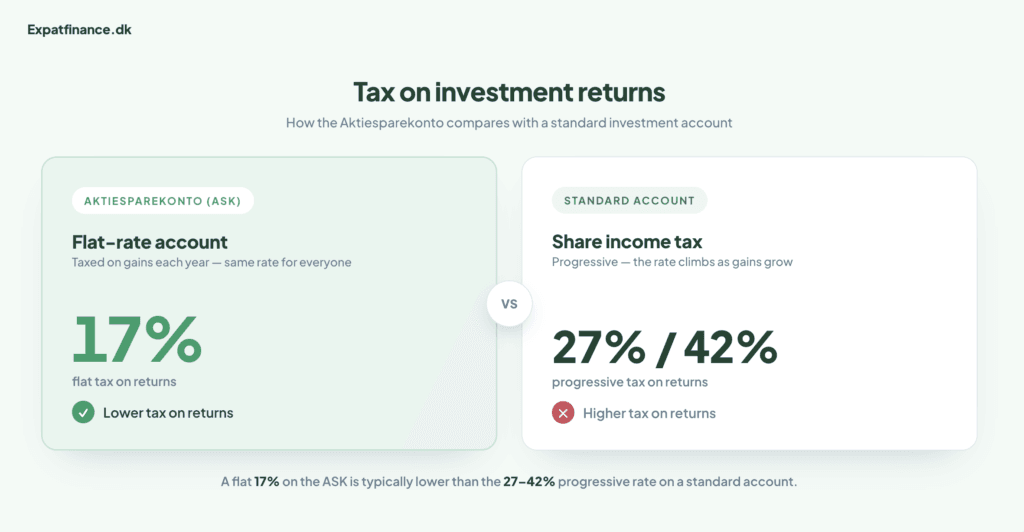
The aktiesparekonto (ASK) taxes investment returns at a flat 17% a year, against the 27% to 42% you’d pay on the same gains in a regular account.
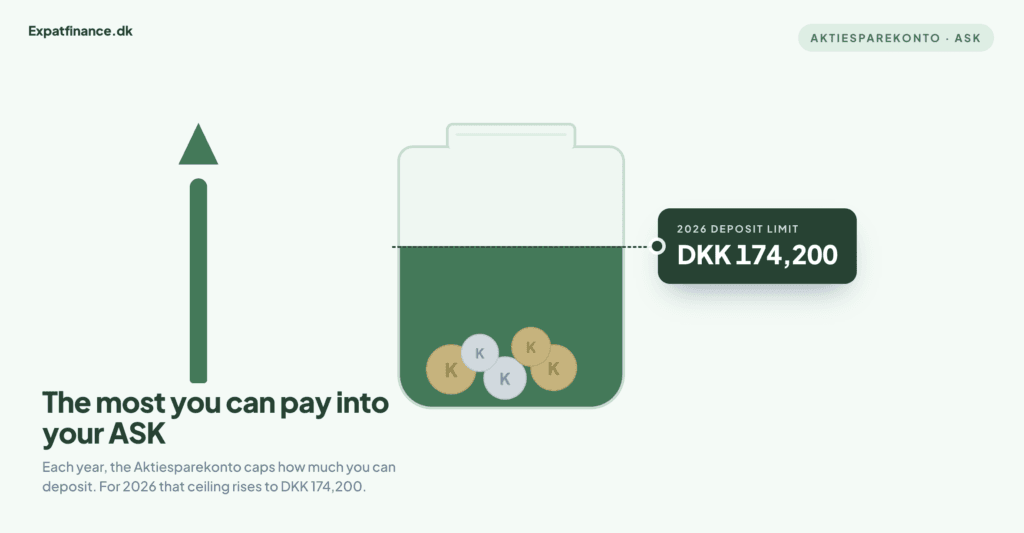
It’s open to anyone with full Danish tax liability (fuld skattepligt), including expats, but Americans should read the PFIC warning below before opening one.The 2026 deposit limit is DKK 174,200, and your broker calculates, deducts, and reports the tax automatically.
ATTENTION US CITIZENS & GREEN CARD HOLDERS
The Aktiesparekonto is an excellent tool for most expats, but for those with US tax obligations, it can be a tax trap. The IRS typically views the Danish ETFs held in an ASK as PFICs, which triggers punitive tax rates and complex reporting. Read our full article regarding ASK and PFIC’s by clicking the link below.
The Danish Aktiesparekonto: A Tax Dream for Danes, A PFIC Nightmare for Americans
- Quick Summary
- What Is the Aktiesparekonto?
- How the Tax Works
- ASK vs. Regular Investment Account (Frie Midler)
- What Can You Invest In?
- The Deposit Limit
- Should You Open One at All?
- How to Open an Aktiesparekonto
- What Should You Invest In?
- Practical Tips
- Example: How the Tax Plays Out
- Common Questions
- Bottom Line
What Is the Aktiesparekonto?
The aktiesparekonto (literally ‘stock savings account’, abbreviated ASK) is a special investment account that taxes returns at a flat 17%. It was introduced on 1 January 2019 with the explicit goal of getting more Danes invested in equities.`
The advantage is simple. Returns in the ASK are taxed at 17%, compared with the 27% to 42% you’d pay on the same returns in a regular account (frie midler). On a DKK 10,000 gain, that’s roughly DKK 1,700 in tax inside the ASK versus DKK 2,700 to 4,200 in a regular depot. Over years of compounding, the gap widens considerably.
Quick Facts
| Detail | Rule |
|---|---|
| Tax rate | 17% flat on all returns (gains, dividends, interest) |
| Tax method | Lagerbeskatning (annual mark-to-market) |
| Deposit limit (2026) | DKK 174,200 total account value at the previous 31 December |
| Accounts per person | One. Children can have their own from age 0. |
| Who can open one | Anyone with full Danish tax liability (fuld skattepligt) |
| Eligible investments | Individual stocks, ETFs on SKAT’s Positivliste, share-based Danish investeringsforeninger |
| Not eligible | Bonds, bond ETFs, ETFs not on the Positivliste, crypto, derivatives |
| Tax payment | Deducted from the ASK by the broker, typically in January or February |
| Withdrawals | Free at any time. No lock-in period. |
| Introduced | 1 January 2019 |
You can open an ASK in a few minutes at Nordnet (partnerlink/reklamelink) or Saxo Bank if you already hold an account there, and at most Danish banks if you don’t mind higher commissions. The broker comparison further down covers the differences.
How the Tax Works
The ASK uses lagerbeskatning (mark-to-market taxation). At the end of each calendar year, your broker calculates the change in your account’s total value, including unrealised gains, dividends received, and any cash movements. You pay 17% on the net gain.
That means tax falls due on paper gains even if you haven’t sold anything. If your holdings rise by DKK 20,000 during the year, you owe DKK 3,400 whether or not you sold. The tax is deducted from your ASK cash balance automatically, typically in January or February of the following year.
If your account falls in value, you pay no tax that year and the loss carries forward, offsetting gains in future years within the same ASK. ASK losses stay inside the ASK; they cannot reduce your aktieindkomst or kapitalindkomst from other accounts. The ASK is its own closed tax ecosystem.Keep enough cash for the tax bill. Overdrafts are not permitted under the aktiesparekontolov, so if there isn’t enough cash in the account when the deduction lands, your broker may sell holdings to cover the shortfall. A buffer of around 3 to 5% of your account value works well, or deposit the estimated amount shortly before the deduction date. Helpfully, Skattestyrelsen always lets you re-deposit the amount deducted as ASK tax, even if you’ve already hit the deposit limit.
Tip
You pay 17% on each year’s gains, realised or not. Losses carry forward inside the ASK. The broker handles everything automatically; you file nothing.
ASK vs. Regular Investment Account (Frie Midler)
The ASK’s flat 17% beats frie midler rates at every income level. Here’s how the two compare:
| Aspect | Aktiesparekonto (ASK) | Frie midler depot |
|---|---|---|
| Tax rate | 17% flat | 27% up to the progressionsgrænse; 42% above it (doubled for married couples) |
| Tax method: ETFs | Lagerbeskatning (annual) | Lagerbeskatning (annual) |
| Tax method: individual stocks | Lagerbeskatning (annual) | Realisationsbeskatning (only when sold) |
| Deposit limit | DKK 174,200 (2026) | No limit |
| Loss deductibility | Only within the ASK (carried forward) | Offsets other aktieindkomst |
| Counts toward other income? | No. The ASK is a closed system. | Yes. Gains can push you into the 42% bracket. |
Two points deserve emphasis. First, the 17% flat rate is always lower than a frie midler depot, where the minimum rate on aktieindkomst is 27% and the marginal rate reaches 42% once your share income passes the progressionsgrænse of DKK 79,400 (doubled for married couples). Second, gains in the ASK never count toward your aktieindkomst, so they can’t push your other dividends or stock gains into the 42% bracket. The ASK is entirely ring-fenced. For a full breakdown, read our guide to capital gains taxes in Denmark.
The trade-off is that individual stocks in a frie midler depot enjoy realisationsbeskatning (you only pay when you sell), whereas everything in the ASK is lagerbeskattet annually on unrealised gains. For long-term buy-and-hold investors, the ASK generates annual tax bills a depot would defer. But the 17% rate is so much lower than 27% to 42% that the ASK almost always wins over any reasonable time horizon.
If you’re weighing an ASK against an existing depot, or you have tax obligations in more than one country (US, UK, or elsewhere), this is the point where it pays to run your situation past a Danish tax adviser or cross-border specialist before you buy anything. The mechanics above hold for most expats on a standard Danish salary; the right sequencing depends on your income, your horizon, and how long you plan to stay in Denmark.
Tip
An hour with a cross-border tax adviser costs far less than unwinding a PFIC problem or a mistimed exit. Book it before you fund the account, not after.
What Can You Invest In?
The aktiesparekonto is restricted to share-based investments. The eligible categories are:
Individual stocks. Any publicly listed stock, Danish or foreign, can be held in the ASK. No restrictions by country or exchange.
ETFs on SKAT’s Positivliste. Only ETFs that appear on the annual list of aktiebaserede investeringsselskaber (share-based investment companies) qualify. Popular eligible ETFs include IWDA/EUNL (iShares MSCI World), VWCE (Vanguard FTSE All-World), WEBN (Amundi Prime All Country World), and IUSQ (iShares MSCI ACWI).
Danish investeringsforeninger (share-based). Danish fund structures like Sparindex or Danske Invest classified as aktiebaserede can be held in the ASK, accumulating and distributing alike.
You cannot hold bonds or bond ETFs, ETFs not on the Positivliste, cryptocurrencies, derivatives (options, futures, CFDs), or structured products.The Positivliste is updated by Skattestyrelsen each year, usually in December for the year ahead, with occasional mid-year additions and the odd removal. For 2026 the list runs to over 5,000 funds, including roughly 900 passive index ETFs. Always confirm a specific ETF is on the current year’s list before buying it in your ASK; you can search by ISIN under ‘Liste over aktiebaserede investeringsselskaber’ on skat.dk. All funds named in this article were on the list as of June 2026.
The Deposit Limit
The 2026 deposit limit is DKK 174,200. The limit is a ceiling on the account’s value rather than an annual contribution allowance: your deposit room for the year is the limit minus your account’s value at the previous 31 December. The ceiling has risen steadily since the ASK launched:
| Year | Deposit limit (DKK) |
|---|---|
| 2019 | 50,000 |
| 2020 | 100,000 |
| 2021 | 102,300 |
| 2022 | 103,500 |
| 2023 | 106,600 |
| 2024 | 135,900 |
| 2025 | 166,200 |
| 2026 | 174,200 |
How the limit works in practice: if your ASK was worth DKK 150,000 on 31 December 2025 and the 2026 limit is DKK 174,200, you can deposit up to DKK 24,200 in 2026. If growth has carried your account above the limit, you can’t add new cash, but nothing needs to be withdrawn; the account is free to keep growing past the ceiling. And whatever your balance, you may always re-deposit the amount your broker deducted as ASK tax.
Excess deposits: if you accidentally deposit too much, withdraw the excess as soon as possible. A 3% charge applies to the excess amount, and Danish brokers will typically calculate and deduct it automatically.
Should You Open One at All?
For most expats, yes, and before a regular depot. Three groups should pause first.
Americans and green card holders. PFIC rules make the ETFs and Danish funds inside an ASK toxic from a US filing perspective. Individual stocks avoid PFIC status, but US reporting still applies. Read the dedicated guide before doing anything.
Short stays. If you expect to leave Denmark within a year or two, the admin of opening, the annual tax cycle, and the exit questions can outweigh the savings on a small balance held briefly. The ASK saves you roughly 10 to 25 percentage points of tax on gains; on a modest sum over a short period, that’s real but limited money. Our guide to what happens to Danish investments when you leave covers the exit side.
Anyone without a cash buffer. The ASK is fully liquid, but equities are no place for next month’s rent. Build the emergency fund first.
Everyone else: the arithmetic favours filling the ASK before anything else.
How to Open an Aktiesparekonto
You’ll need a Danish CPR number and full Danish tax liability (fuld skattepligt). As an expat living and working in Denmark, you’ll normally qualify.
You can hold one ASK only. Switching providers means transferring the entire account, which can take several weeks and may force you to sell positions, since some providers don’t support in-kind ASK transfers. It pays to pick the right broker first.
| Feature | Saxo Bank | Nordnet |
|---|---|---|
| ASK available | Yes | Yes |
| ETF and stock range | Wide; global exchanges | Wide; global exchanges |
| Commission | Low | Low |
| Månedsopsparing for the ASK | Not available | Not available |
| Account opening | A few clicks within an existing account | A few clicks within an existing account |
Most Danish retail banks (Danske Bank, Nordea, Jyske Bank, and others) also offer the ASK, usually with a narrower fund range, higher commissions, and clunkier platforms. For low-cost index investing, the two specialist platforms are the natural choice.
One thing that matters more to expats than to the Danish bloggers who dominate this topic is language: which platform you can actually navigate, and whether the annual tax summary arrives in English. On cost and range, the two platforms land close together. If you already bank or invest with one of them, open your ASK there; keeping everything in one place makes January’s tax season simpler. Starting from scratch, Nordnet (partnerlink/reklamelink) is our pick, and the process looks like this:
- Create or log in to your account at Nordnet (partnerlink/reklamelink). Identity verification runs through MitID, and you’ll need your CPR number.
- Choose the aktiesparekonto as the account type. Existing customers can add it in a few clicks under account settings.
- Transfer your deposit, staying under the DKK 174,200 cap; the platform won’t always stop you at the line.
- Buy your fund or stocks. If it’s an ETF, check the Positivliste first.
Existing customers are typically done in minutes; brand-new customers should allow a few days for identity checks before the account is live.
What Should You Invest In?
Everything in the ASK is lagerbeskattet regardless of what you hold, so the deciding factors are cost, diversification, and simplicity. The most common approaches:
A single global ETF. The simplest and most popular strategy: one broad, accumulating, low-cost ETF covering the global stock market. Popular choices include WEBN (Amundi Prime All Country World, TER 0.07%), IUSQ (iShares MSCI ACWI, TER 0.20%), VWCE (Vanguard FTSE All-World, TER 0.22%), and IWDA/EUNL (iShares MSCI World, TER 0.20%, developed markets only). All are on the 2026 Positivliste.
Individual stocks. Some investors use the ASK for concentrated positions in companies they have high conviction in. Any publicly listed equity qualifies.
Danish investeringsforeninger. Funds like Sparindex Globale Aktier (SPVIGAKL) or Danske Invest Global Indeks can be held in the ASK. In a frie midler depot these funds enjoy realisationsbeskatning, an advantage the ASK removes, so the cheaper ETFs are generally the better choice here.
Practical Tips
You can’t move existing positions in. Transferring stocks or ETFs from a regular depot into the ASK is off the table. You’d sell in the depot (potentially triggering a taxable event) and repurchase inside the ASK with deposited cash.
Watch the Positivliste each January. If an ETF drops off the list, it becomes ineligible for the ASK and you’d need to sell it within the account. Rare for the major global ETFs, but worth a yearly check.
Children can have one too. Parents can open an aktiesparekonto for a child from age 0. The same DKK 174,200 limit applies per child, separate from the child’s børneopsparing.
No månedsopsparing for the ASK. Nordnet’s commission-free monthly savings feature doesn’t cover the ASK. You place trades manually and pay standard commission. The same applies at Saxo.
Currency costs. Most global ETFs trade in EUR. Buying a EUR-priced ETF through a DKK-denominated ASK costs a currency conversion spread, typically around 0.25% at both major platforms. It’s a one-off cost on each purchase and sale, rather than an annual drag.
Example: How the Tax Plays Out
Suppose you opened an ASK on 1 January 2026 and deposited the full DKK 174,200 into a single global ETF, and the next three years returned +12%, then -8%, then +15%. Here’s a simplified picture (figures rounded):
| Year | Annual return | Value after tax |
|---|---|---|
| 2026 | +12% (gain DKK 20,904) | DKK 191,550 |
| 2027 | -8% (loss DKK 15,324) | DKK 176,226 |
| 2028 | +15% (gain DKK 26,434) | DKK 200,771 |
In year one, the 17% bill comes to DKK 3,554 on the DKK 20,904 gain. In year two, no tax is due and the DKK 15,324 loss carries forward. In year three, the carried loss offsets part of the gain, so tax of DKK 1,889 falls on the net DKK 11,110 only.
After three years, DKK 174,200 has grown to roughly DKK 200,771 after all tax. In a frie midler depot taxed at 27% to 42%, the after-tax result would be noticeably lower.
Common Questions
Can I withdraw money from my ASK at any time? Yes. There’s no lock-in; sell positions and withdraw cash whenever you like. Withdrawing creates no extra deposit room in the same year, since the year’s room is fixed by your account value at the previous 31 December. A withdrawal does lower next year’s starting point, though.
Can my spouse have one too? Yes. The limit applies per person, so a couple can each fill an ASK. Unused room can’t be shared or pooled between spouses.
Can I have an ASK and a regular depot? Yes, and most investors run both: fill the ASK first, then let the overflow go into frie midler.
What happens if I leave Denmark? If you cease to have full Danish tax liability (for example, by moving abroad permanently), you can generally keep the ASK open. The tax treatment may change, and some brokers may require non-residents to close the account, so check with your broker and a tax adviser before emigrating.
Do I need to report anything to SKAT? No. With a Danish broker (Saxo, Nordnet, or a Danish bank), the tax calculation, deduction, and reporting all happen automatically. Nothing goes on your tax return for the ASK.
Bottom Line
For most expats on a standard Danish salary, the ASK is the single most valuable investment account available. The 17% flat rate, automatic tax handling, and full liquidity make it worth filling before a krone goes into a regular depot. For Americans, PFIC exposure turns the same account into a problem; read the dedicated guide before opening one.
Disclaimer
This article is for informational purposes only and does not constitute financial, tax, or investment advice. Figures reflect publicly available data at time of writing. Always consult a qualified professional regarding your specific situation. See our full disclaimer.