Last Updated
Affiliate links
Some links in this article are partner links (reklamelinks). If you click through and sign up or make a purchase, ExpatFinance.dk may earn a commission at no extra cost to you. This helps cover the cost of running the site and keeping the content free. It doesn’t affect which products we cover or what we say about them.
Quick Summary
Månedsopsparing is an automated monthly investment service offered by Danish brokers: it buys funds or ETFs on your behalf each month, usually with no trading fees. Relevant to expats resident in Denmark who want to invest consistently without manual transfers or market-timing decisions. Both Nordnet and Saxo support månedsopsparing inside an Aktiesparekonto (ASK), where gains are taxed at a flat 17% rather than the standard 27%–42% aktieindkomst rates. The ASK contribution limit in 2026 is DKK 174,200.
- Quick Summary
- What Månedsopsparing Actually Does
- Why Monthly Automatic Investing Tends to Work
- Nordnet's Månedsopsparing: Four Options
- Saxo Bank and Other Platforms
- Using Månedsopsparing Inside an Aktiesparekonto (ASK)
- The Tax Situation
- What to Actually Invest In
- Specific Considerations for Expats
- Is Månedsopsparing Right for You?
- Getting Started
- Bottom Line
If you’ve spent any time in Danish personal finance circles, you’ve probably seen “månedsopsparing” come up constantly. The name translates literally as “monthly savings,” which is slightly misleading. It’s not a savings account.
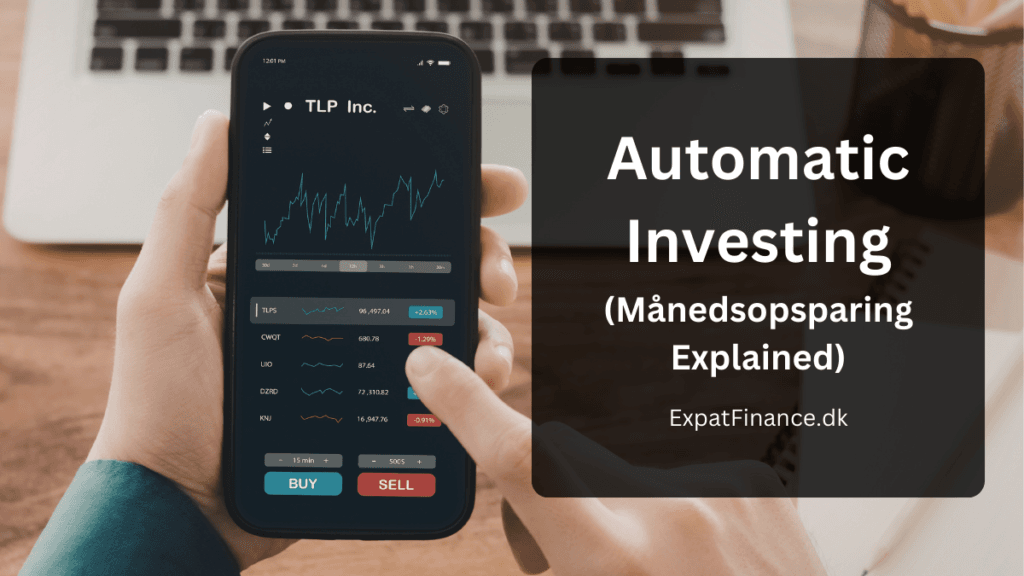
It’s an automated investment service. You choose which funds to buy each month, you choose the amount, and the platform executes the purchase for you. Fixed date, every month, no action required from you.
Here’s how it works, what each platform offers, and what the Danish tax rules mean for your returns.
What Månedsopsparing Actually Does
The big Danish brokers (Nordnet, Saxo Bank, Danske Bank, Nordea) all offer their own version of this service. The mechanics are the same across all of them: you tell the platform which funds or ETFs to buy, you specify a monthly amount, and it makes the purchase automatically on a set date each month.
The most significant feature is the fee structure. Normally, every buy order carries a transaction fee (kurtage). With månedsopsparing, most platforms waive that fee entirely for the automatic monthly purchase. You only pay when you sell.
That matters more than it sounds. A DKK 29 kurtage on a DKK 500 monthly investment is nearly 6% gone before the market has done anything. With månedsopsparing, that DKK 500 goes into the fund.
Why Monthly Automatic Investing Tends to Work
There are 3 structural reasons this approach has become the default recommendation in Danish personal finance circles.
| Principle | What it means in practice |
| Automation removes friction | Most people don’t invest consistently because they forget, procrastinate, or second-guess themselves when the market looks uncertain. Automation removes all of those failure points. The purchase happens whether you’re paying attention or not. |
| Cost-averaging over time | Investing a fixed amount monthly means you buy more units when prices are low and fewer when prices are high. Over a long period, this smooths out the timing risk of investing a lump sum at the wrong moment. |
| Low minimums make it accessible | Depending on the platform and option, you can start with as little as DKK 100 per month. That removes the psychological barrier of needing a meaningful lump sum before starting. |
Nordnet’s Månedsopsparing: Four Options
Nordnet (partnerlink/reklamelink) is the most popular platform among expats. It offers 4 distinct månedsopsparing options, each with different levels of guidance and minimum investment amounts.
| Option | How it works |
| 1. Nordnet guided | Nordnet asks about your risk tolerance and time horizon, then suggests a portfolio. Best for complete beginners. Minimum DKK 100/month. No fee. |
| 2. Nordnet’s own index funds | You pick from Nordnet’s own index fund range (global stocks, Danish stocks, emerging markets, etc.). Same minimum: DKK 100/month. No fee. Note: these funds are taxed as kapitalindkomst, not aktieindkomst (see the tax section below). |
| 3. Broader fund selection, assisted | Nordnet helps you choose from a wider range beyond its own funds. Minimum DKK 1,000/month. Fee: DKK 0/month. |
| 4. Full self-directed selection | You choose any fund or ETF on the Nordnet platform. Minimum DKK 500/month in total (split across multiple funds if you like). Fee: DKK 0/month. |
Purchases happen on the 8th of each month (or the next business day if it falls on a weekend or public holiday). There’s no lock-in period: you can change amounts, swap funds, or cancel at any time.
Automated Savings
Whichever option you choose, the real power is in the either free or low cost automatic investing. By automating any investment decision each month, you combine the power of dollar (or Krone) cost averaging and compounding to help build long term wealth.
Saxo Bank and Other Platforms
Saxo Bank offers a comparable service under the same name. You can run up to 10 separate månedsopsparinger simultaneously, which is useful if you’re splitting contributions across different funds or accounts. There’s no minimum monthly amount and no fee for the service.
Saxo’s platform gives access to a broad international fund and ETF selection, which is its main advantage over Nordnet for investors who want something beyond the standard Nordic/global index offerings.
Danske Bank and Nordea both offer their own versions (Danske Månedsinvestering and Nordea’s månedsopsparing). These work well if you’re already banking with them and want to keep everything in one place. The fund selection tends to be narrower than the specialist investment platforms, which is a real constraint if you’re looking for specific ETFs.
Using Månedsopsparing Inside an Aktiesparekonto (ASK)
Both Nordnet and Saxo let you connect månedsopsparing to your ASK. This is the combination most Danish personal finance resources recommend for long-term equity investing.
Inside the ASK, gains are taxed at a flat 17% annually (on both realised and unrealised gains) rather than the standard aktieindkomst rates. The contribution limit in 2026 is DKK 174,200.
The constraint is fund eligibility. The ASK only accepts stocks and stock-based funds or ETFs that appear on SKAT’s approved list. Both platforms flag eligible funds clearly when you’re setting up, so this is less of a practical obstacle than it sounds.
Americans should stop here. The ASK’s tax structure creates a PFIC problem for US citizens, and the combination of Danish annual mark-to-market taxation and US PFIC rules can produce outcomes significantly worse than a standard taxable account. If you hold a US passport, take specific advice before opening an ASK.
Tip
Whether your specific US tax situation makes the ASK workable or not depends on details of your return, treaty positions, and how you hold other assets. This is where a cross-border tax adviser earns their fee. Do not act on the general rule without checking the specific application.
The Tax Situation
Tax treatment depends on what you’re buying and which account type you’re using.
| Account / Fund type | Tax treatment |
| ASK (aktiesparekonto) | 17% annual lagerbeskatning on all gains (realised and unrealised). Broker reports to SKAT automatically. |
| Regular account: aktieindkomst-eligible funds | 27% on the first DKK 79,400 of gains (DKK 158,800 for couples), 42% above that. Taxed on realisation: you only pay when you sell. Covers most individual stocks, ETFs on SKAT’s positive list, and Danish stock funds with 50%+ in equities. |
| Regular account: kapitalindkomst funds | Taxed at your marginal rate, which can range from roughly 37% to 42% depending on your total income. Usually lagerbeskatning (annual mark-to-market). Applies to bonds, some ETFs not on the positive list, and Nordnet’s own index funds. |
Tip
If your fund is on SKAT’s positive list and you’re in a regular account, you pay aktieindkomst rates on realisation. If it’s a Nordnet index fund or a bond fund, expect kapitalindkomst treatment with annual taxation. The ASK caps everything at 17% but has a contribution limit.
The practical upside: Danish brokers handle all the reporting. Nordnet and Saxo send the relevant figures directly to SKAT, and they appear in your annual tax assessment (årsopgørelse). You don’t calculate anything yourself.
What to Actually Invest In
This is where any honest answer has to acknowledge limits. What makes sense depends on your time horizon, your tax situation, your home country obligations, and how you’re already invested elsewhere. The below describes what many Danish investors do. It’s not a recommendation for your situation.
- Long time horizon (10+ years): Globally diversified stock index funds. These hold a slice of thousands of companies across different markets, which spreads single-company and single-country risk. This is the most common approach in Danish personal finance communities.
- Shorter horizon or lower risk tolerance: Balanced funds (stocks plus bonds) or bonds. The closer you are to needing the money, the less you probably want in equities.
- ASK optimisation: Many people put their highest-expected-return funds (tech-heavy, emerging markets) in the ASK to apply the 17% rate to what they hope will be the largest gains. Lower-volatility holdings go in the regular account.
One to 3 funds covering different parts of the market is a common and reasonable starting point. The compounding benefit of consistent investing over time tends to outweigh the marginal gain from picking the “optimal” fund.
Specific Considerations for Expats
Danish investing is accessible to expats, but a few things are worth thinking through before you set anything up.
| Issue | What to consider |
| How long you’re staying | If you might leave Denmark in 2–3 years, you need a plan for your investments when you go. Selling before you leave has one set of tax consequences; holding them in Denmark after departure has another. Neither is necessarily better. They’re just different, and the right answer depends on where you’re going. |
| Tax treaties | If you leave Denmark while still holding Danish investments, the tax treaty between Denmark and your new country of residence determines how ongoing investment income is taxed and whether you get a credit for Danish withholding. These treaties vary significantly. |
| Currency exposure | Many Danish-listed global funds are denominated in DKK but hold assets in USD, EUR, and other currencies. If you plan to eventually repatriate your savings to your home country, factor in exchange rate risk over your investment horizon. |
| Home country reporting | Some countries require residents (or citizens) to disclose foreign investment accounts regardless of where they live. The US is the most demanding example: FBAR, FATCA, and PFIC rules all interact with Danish investment accounts. Check your own country’s requirements before investing. |
Is Månedsopsparing Right for You?
It fits most situations where someone wants to invest consistently over a long period without actively managing the process. The automation, the fee structure, and the low minimums make it accessible.
It’s less suited to active trading strategies, very short investment horizons, or situations where you need precise control over the timing and size of every purchase.
The honest version: if you’re going to put off investing because it feels complicated or you’re waiting for the “right moment,” månedsopsparing removes both those obstacles. You set it up, it runs, and the timing problem disappears by design.
Getting Started
Opening an account with Nordnet or Saxo as a foreigner takes a few weeks. Both require identity verification and your CPR number, and the process is more involved than opening a domestic Danish bank account. Factor in that lead time before expecting to be up and running immediately.
Once you’re in, the månedsopsparing setup is straightforward. You’ll choose the option type (guided vs self-directed), select your funds, and set your monthly amount. Then set up an automatic bank transfer so the money arrives in your investment account before the purchase date.
Starting small is fine. You can always increase the amount once you’ve seen how the platform works and what shows up in your tax assessment.
Bottom Line
Månedsopsparing is the closest thing Denmark has to a default “just invest and stop thinking about it” solution. The automatic purchases, no trading fees on buys, and low minimums make it practical for almost any budget. Pairing it with an ASK adds meaningful tax efficiency for most investors but Americans specifically need to take advice before opening one, because the ASK’s annual taxation structure collides badly with US PFIC rules.
Risk disclosure/Risikooplysning
The mention of specific securities and investments does not constitute a recommendation, and is not an offer or solicitation to buy or sell. Past performance is not a guarantee of future returns. Financial instruments can rise as well as fall in value. There is a risk that you may not get back the amount you invested. Before investing in a fund, you should read the prospectus, available from the fund company, and the key investor information document (KID), which you can find in the order window and on the fund’s product page at nordnet.dk.
Omtalen af de konkrete værdipapirer og investeringer er ikke en anbefaling vedrørende disse, og er ikke et tilbud eller opfordring til tilbud om køb eller salg. Historisk afkast er ingen garanti for fremtidigt afkast. Finansielle instrumenter kan både stige og falde i værdi. Der er en risiko for, at du ikke får de investerede penge tilbage. Inden du investerer i en fond, bør du læse prospektet, som er tilgængeligt hos fondsselskabet og central investorinformation, som du finder i ordreafgivelsesvinduet samt på fondens produktside på nordnet.dk.
Disclaimer
This article is for informational purposes only and does not constitute financial, tax, or investment advice. Figures reflect publicly available data at time of writing. Always consult a qualified professional regarding your specific situation. See our full disclaimer.