Last Updated
Quick Summary
Expats who have lived in Denmark for 5 continuous years can buy a summer house without special permission. Everyone else needs Ministry of Justice approval, and it’s granted only to those who can demonstrate particularly strong ties to Denmark. The LTV limit for summer house mortgages is 75%, versus 80% for primary residences. Most expats should budget a 25-40% down payment in practice. If you rent through a registered agency, the first DKK 50,200 of annual rental income is tax-free in 2026. Tax applies to 60% of income above that threshold.
- Quick Summary
- What a Sommerhus Actually Is
- You Cannot Live There Year-Round
- Who Can Buy Without Special Permission
- What 'Strong Ties to Denmark' Actually Means
- Financing: Stricter Than You'd Expect
- Registration Fees and Purchase Costs
- What It Costs to Own One
- Renting It Out: The Tax Treatment
- The Permission Process If You Need It
- What Summer Houses Cost by Location
- If You Can't Buy Yet
- Is It a Good Investment? Honestly, No.
- Mistakes Worth Knowing About
- Common Questions
- Bottom Line
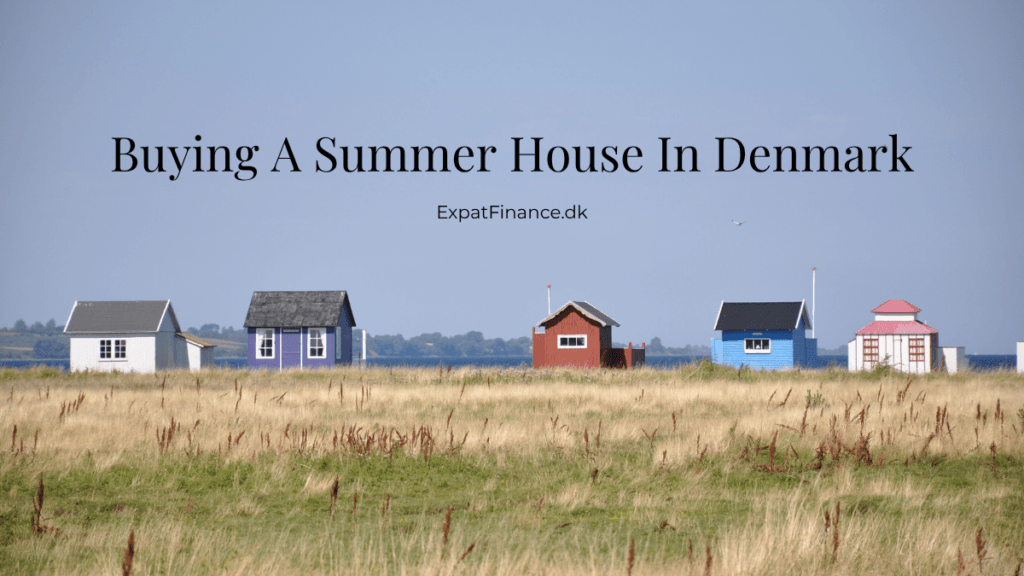
A wooden cottage by the sea. Dunes. Pine trees. Long summer evenings on a deck watching the light fade over the Kattegat. The Danish sommerhus dream is real, and for many expats who’ve planted roots here, owning one feels like the ultimate commitment to Danish life.
It also comes with more legal complexity, stricter financing, and harder-to-navigate restrictions than almost any other property purchase in Denmark. The rules exist specifically to keep foreign ownership limited, and they haven’t softened.
Here’s what you actually need to know before you start browsing Boligsiden.
What a Sommerhus Actually Is
Legally, a fritidsbolig (leisure dwelling) is a property zoned for holiday and recreational use only. It can’t serve as your permanent registered address (folkeregisteradresse) in the CPR system, full stop. These properties sit in designated sommerhusområder, zoned specifically to keep their recreational character and prevent them from becoming residential suburbs.
Culturally, the sommerhus is embedded in the Danish identity in a way that’s hard to overstate. It’s where families go to disconnect, where hygge is most palpable, and where three generations often end up around the same kitchen table. Denmark has over 220,000 of them for a population of 6 million. This isn’t a niche market.
You Cannot Live There Year-Round
This trips up more expats than any other rule. The seasonal restrictions are enforced, not advisory.
Summer period (1 March to 31 October): Unrestricted use during these 8 months.
Winter period (1 November to end of February): Use is restricted to short-term stays. Common practice and municipal enforcement suggest total winter stays should not exceed roughly 9 weeks across the full 4-month period, with individual stays typically limited to 4-5 consecutive weeks.
The pensioner exception: Owners who are pensioners and have owned the property for at least 1 year can apply for permission to live there year-round. This is the only mainstream exemption.
Municipalities actively monitor compliance. Violations can result in fines, forced sale, or prosecution. Leaving for a day to reset the clock is a well-known workaround the authorities are wise to.
Important To Know
You can’t register a summer house as your permanent address. Winter use is capped at roughly 9 weeks total. The rules are enforced.
Who Can Buy Without Special Permission
The rules on foreign ownership of summer houses are stricter than for primary residences. Denmark negotiated a specific EU Treaty exemption when it joined the EC in 1973, which means even EU/EEA citizens face restrictions that don’t apply when buying a permanent home.
| Category | What you need |
| Danish citizens | Nothing. Buy freely. |
| Lived in Denmark continuously for 5+ years | Nothing. Buy freely. |
| EU/EEA citizens, less than 5 years in Denmark | Ministry of Justice permission |
| Non-EU/EEA citizens (any length of residence) | Ministry of Justice permission |
The 5-year rule requires continuous residence, not cumulative years across different periods. If you left Denmark for 2 years mid-way through, the clock restarts.
Permission is granted by the Department of Civil Affairs (Civilstyrelsen), operating under the Ministry of Justice. Crucially, permission is property-specific, not general. You identify the property you want to buy, make a conditional offer, and then apply for permission to buy that specific property. A review typically takes around 10 weeks once all documentation is submitted.
Tip
If you’re close to the 5-year mark, the calculation is worth doing carefully before you start viewing properties. Applying without meeting the threshold wastes time and costs legal fees. If you’re 6 months away from qualifying automatically, renting for another summer and buying without any permission process is probably the cleaner path.
What ‘Strong Ties to Denmark’ Actually Means
Permission requires demonstrating a particularly strong connection to Denmark. The Ministry of Justice assesses applications case by case, looking at:
- Family ties: Danish spouse, Danish children, parents or siblings living in Denmark
- Long-term employment in Denmark or business ownership
- Language: speaking Danish
- Cultural integration: involvement in Danish society, associations, community life
- Property ownership: already owning other property in Denmark
- History of stays: regular, significant vacations in Denmark over many years
Reality check: special permission is rarely granted and many applications are refused. If you’ve been in Denmark less than 3 years and don’t have a Danish spouse or other close family connections, the odds are low. The rule was designed to keep summer houses accessible to Danes with average incomes, and that intent is still reflected in how applications are assessed.
Financing: Stricter Than You’d Expect
The LTV limit for summer house realkredit (mortgage) loans is 75 %, versus 80 % for owner-occupied primary residences. Banks view summer houses as higher-risk collateral, and foreign buyers as higher-risk borrowers. That combination tends to push requirements further.
For expats without a long Danish banking history, a 30-35% down payment is a more realistic planning figure than the legal minimum.
Example: DKK 2,000,000 summer house
Scenario A: Danish buyer, established banking relationship
Down payment (25%): DKK 500,000
Realkredit loan (60%): DKK 1,200,000
Bank top-up loan (15%): DKK 300,000
Scenario B: Expat, under 5 years in Denmark
Down payment (35-40%): DKK 700,000-800,000
Realkredit loan (50-60%): DKK 1,000,000-1,200,000
Note: interest rates for realkredit loans vary. Verify current rates with your bank before modelling costs.
Registration Fees and Purchase Costs
On top of the purchase price and down payment, budget for these upfront costs. None of them are avoidable.
| Cost item | Amount |
| Deed registration (tinglysningsafgift) — fixed | DKK 1,850 |
| Deed registration — variable | 0.60% of purchase price |
| Mortgage registration — fixed | DKK 1,825 |
| Mortgage registration — variable | 1.25% of loan amount |
| Solicitor fees (boligadvokat) | Typically DKK 15,000-25,000 |
| Building inspection (tilstandsrapport) | Typically DKK 8,000-12,000 |
On a DKK 2,000,000 purchase with a DKK 1,300,000 mortgage, registration fees alone come to roughly DKK 30,000-35,000 before legal and inspection costs.
What It Costs to Own One
The purchase price is the beginning. Annual running costs including property taxes, insurance and maintenance on a mid-range summer house typically run DKK 30,000-80,000 depending on size, age, condition, and how much you use it.
| Cost category | Annual range (DKK) |
| Property value tax (ejerafgift) | 1,000-6,000 |
| Land tax (grundskyld) | 2,000-8,000 |
| Building and contents insurance | 4,500-12,000 |
| Utilities (electricity, water, heating) | 9,000-28,000 |
| Routine maintenance | 10,000-25,000 |
| Major repairs (budget over 5-10 year cycle) | 50,000-150,000 per event |
Danish coastal weather is rough on wood and paint. Roofs, cladding, and pipework degrade faster than in a city flat. Budget realistically for maintenance rather than assuming a well-presented property won’t need attention.
Renting It Out: The Tax Treatment
Most summer house owners offset costs by renting when they’re not using the property. The tax treatment for agency rentals is generous.
If you rent through a registered agency (Novasol, DanCenter, Sol og Strand, and others), the first DKK 50,200 of annual rental income is tax-free in 2026. Above that threshold, you pay tax on 60% of the excess, not 100%.
Private rental (not via a registered agency) carries a much lower exemption: DKK 13,800 in 2026. The agency route is substantially more valuable for most owners.
Example: 16 weeks rented via agency at DKK 8,000/week
Gross rental income: DKK 128,000
Tax-free allowance (agency): DKK 50,200
Excess above threshold: DKK 77,800
Taxable amount (60% of excess): DKK 46,680
Tax owed (at approx. 42% marginal rate): ~DKK 19,600
Agency commission (~25% of gross): DKK 32,000
Net rental income after tax and commission: ~DKK 76,400
That’s enough to cover property taxes, insurance, and utilities in a typical year, meaning the mortgage becomes your primary actual cost. Rental doesn’t eliminate ownership costs, but it changes the economics meaningfully.
The trade-off: agency rental means less flexibility for spontaneous trips, wear and tear from guests, and coordination with the agency calendar.
The Permission Process If You Need It
If you need Ministry of Justice approval, the process runs roughly as follows:
- Find a specific property and make a conditional offer (conditional on permission being granted).
- Engage a Danish property solicitor (boligadvokat) experienced in foreign buyer applications.
- Gather documentation: passport, CPR documentation, proof of Danish ties (employment contracts, residence history, family documentation), and a written statement explaining your connection to Denmark.
- Submit the application to Civilstyrelsen through their portal. Allow approximately 10 weeks for review.
- If approved: complete the purchase within the specified timeframe. If refused: the conditional offer expires. Approval is property-specific; a refusal on one property doesn’t prevent applying for another.
Advice Is Worth It
The application is only as strong as its documentation. A Danish lawyer who handles these applications regularly knows what evidence the Ministry actually weighs and how to present ties to Denmark clearly. DIY applications tend to be thinner than they should be. This is a case where the legal fee is worth it upfront.
What Summer Houses Cost by Location
Prices span a wide range. Location is the dominant variable, followed by proximity to the coast, condition, and plot size.
| Area | Typical price range |
| North Zealand (Nordsjælland) | DKK 2,500,000-6,000,000+ |
| Skagen (northern tip of Jutland) | DKK 3,000,000-8,000,000+ |
| Bornholm | DKK 1,800,000-4,000,000 |
| West Jutland coast | DKK 1,200,000-3,500,000 |
| Funen and South Jutland | DKK 900,000-2,500,000 |
These are illustrative ranges drawn from market listings. Summer house prices are volatile and vary significantly within each region based on waterfront access and property condition. Verify with a local estate agent before drawing conclusions.
If You Can’t Buy Yet
Not eligible, or not ready to commit? There are sensible alternatives.
Weekly rental through agencies: DanCenter, Novasol, Sol og Strand, and others list thousands of properties. DKK 5,000-20,000+ per week depending on season and location. You get the experience, the areas, the neighbourhoods, without the commitment.
Seasonal rental: Some owners rent out for an entire season or year at rates far below equivalent weekly bookings. Less flexible, but gives you a more immersive sense of whether you’d actually use a summer house if you owned one.
Co-ownership: Buying jointly with a Danish friend or family member who meets the ownership requirements is possible, but requires clear legal agreements to protect everyone’s interest. A property lawyer is essential here.
Is It a Good Investment? Honestly, No.
Summer house appreciation has broadly tracked inflation historically, not beaten it. High carrying costs, illiquidity, a single-market asset that can’t be relocated, and usage restrictions that limit utility all work against pure financial returns.
People buy anyway because the lifestyle value is real. Family legacy. Cultural integration. Forced savings in an illiquid asset. Quality time that wouldn’t otherwise happen. Those things are worth money to different people in different amounts.
The right frame is: treat it as a lifestyle purchase that might roughly break even financially over a long hold. If you’re buying for returns, listed equities or a rental property in a city will likely outperform.
Mistakes Worth Knowing About
Assuming you can live there most of the year. The winter restrictions are enforced. Budget for March-October as your primary use window.
Not budgeting for ongoing costs. The purchase price is the beginning. Annual costs of DKK 30,000-80,000 arrive reliably regardless of how much you use the property.
Falling for a property before confirming eligibility. Check whether you actually qualify to buy before you start viewing. Permission applications take weeks and are property-specific.
Underestimating maintenance. Coastal weather is hard on timber and paint. A property that looks good today may need a new roof or replumbing within 5 years.
Buying too far from where you live. If it’s more than 90 minutes away, you’ll use it far less than you plan. The owners who get the most value are the ones who can get there on a Friday evening without it feeling like an expedition.
Not renting it out when you’re not using it. If you’ll only use it 4-6 weeks a year, rental income can cover a significant portion of running costs.
Common Questions
Can I buy if I’ve only been in Denmark 2 years?
You can apply for special permission. Approval is unlikely unless you have exceptional ties, such as a Danish spouse, Danish children, or other strong family connections in Denmark.
What happens if I buy without permission?
The sale can be declared invalid. You can be required to sell, and penalties may apply. There is no grace period once a violation is identified.
Can I convert a summer house to a primary residence?
Generally no. Zoning changes in sommerhusområder are extremely difficult to obtain, and most areas explicitly prohibit year-round residence.
Will buying a summer house help with my residence permit?
No. Property ownership has no bearing on residence permits or citizenship applications in Denmark.
What if I leave Denmark? Can I keep the summer house?
This depends on your circumstances and how long you’ve owned the property. A Danish property lawyer can advise on your specific situation before you leave.
Can I rent my summer house on Airbnb?
Airbnb reports income to SKAT under the same framework as registered agencies, so the agency deduction may apply. However, some municipalities restrict short-term rental in sommerhusområder entirely. Check local planning rules before listing.
Bottom Line
If you’ve been in Denmark for 5 years, buying a summer house is open to you with the same process as any other property. If you haven’t, you’re looking at a Ministry of Justice application that requires demonstrating real, documented ties to Denmark, and it isn’t guaranteed. Wait until you’ve been here 5 years if you’re close to that threshold. You’ll qualify automatically, you’ll know Denmark well enough to pick the right area, and you’ll have a much clearer sense of whether a summer house actually fits how you live. For everyone else: rent first. The sommerhus experience is accessible without ownership, and those 220,000 properties aren’t going anywhere.
Disclaimer
This article is for informational purposes only and does not constitute financial, tax, or investment advice. Figures reflect publicly available data at time of writing. Always consult a qualified professional regarding your specific situation. See our full disclaimer.